In the final week of Northwestern’s Spring 2023 quarter, as most of my PhD cohort members were finishing grading and heading to Lake Michigan to kick off the summer, I was off on a flight to Mumbai, India (and by flight, I mean two 8-hour flights with a multi-hour stopover in Germany!). I had never been to India before and was going to spend two weeks exploring the city, eating lots of food, and most importantly, meeting up with collaborators at the Humsafar Trust, an NGO in Mumbai that promotes LGBTQ+ rights, with whom I’ve been working virtually on research projects for the past 2 years.
Arriving in Mumbai
Just before leaving for Mumbai, I attended the Taylor Swift Eras tour concert at Soldier Field in Chicago with over 60,000 people (yes, I finally got to live out my high-school dreams of belting Love Story and watching Taylor’s incredible 3+ hour performance). I bring this up as one of my Indian friends with whom I went to the concert joked as we were leaving the concert, stuck in crowds of people, that this would be good preparation for my trip… I understood what she meant when arriving in Mumbai as one of my first observations was the sheer amount of people everywhere! While driving along the streets to the hotel, despite it being 2 AM, I saw food stalls with crowds gathered around, people walking, hanging out, or sleeping by the highway, and motorbikes packed with 5 people racing by. Having spent time in Kampala, Uganda for fieldwork for my undergraduate honors thesis in January 2020, some of these sites were familiar to me, yet it was still shocking compared to my relatively quiet neighborhood in Andersonville, Chicago.
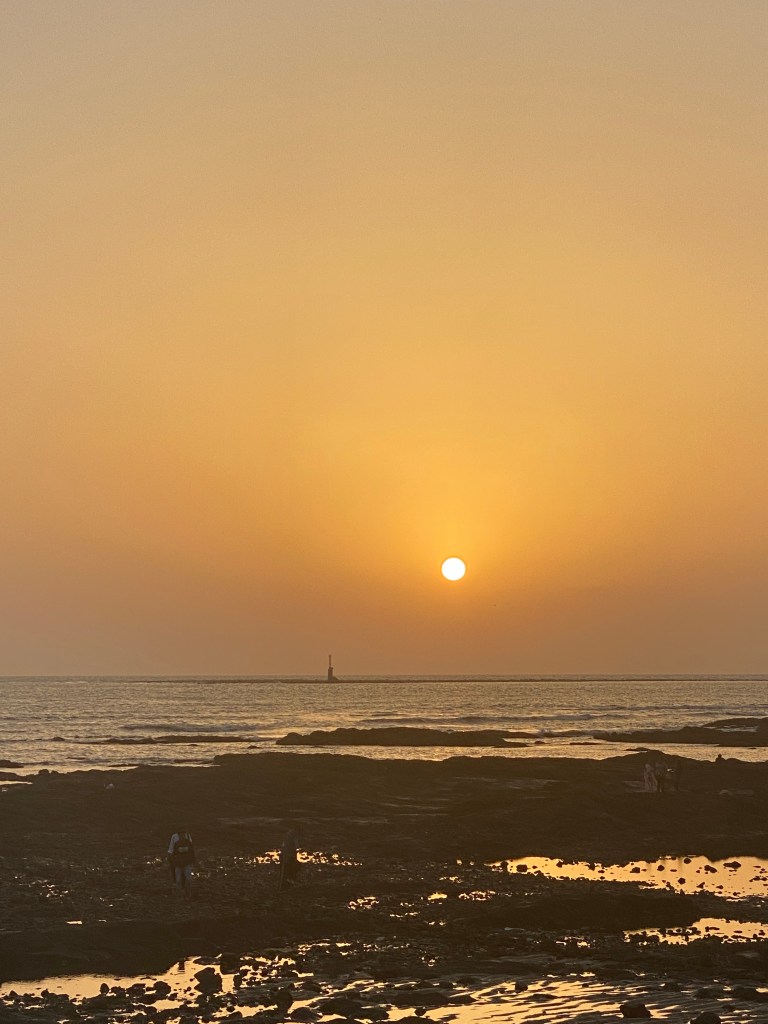
I quickly adapted to life in Mumbai: the cacophony of horns, the tropical (though sometimes too hot) June air with pre-monsoon light rains, the beautiful orange sunsets, and the general vibrancy of the city. Riding rickshaws became one of my favorite activities whether it be speeding down side-alleys, cruising along the coast and feeling the wind off the Arabian sea, or watching in amazement (and slight fear) as the driver would navigate trucks, motorbikes, and people that were always within inches of our rickshaw.
Meeting with Research Collaborators
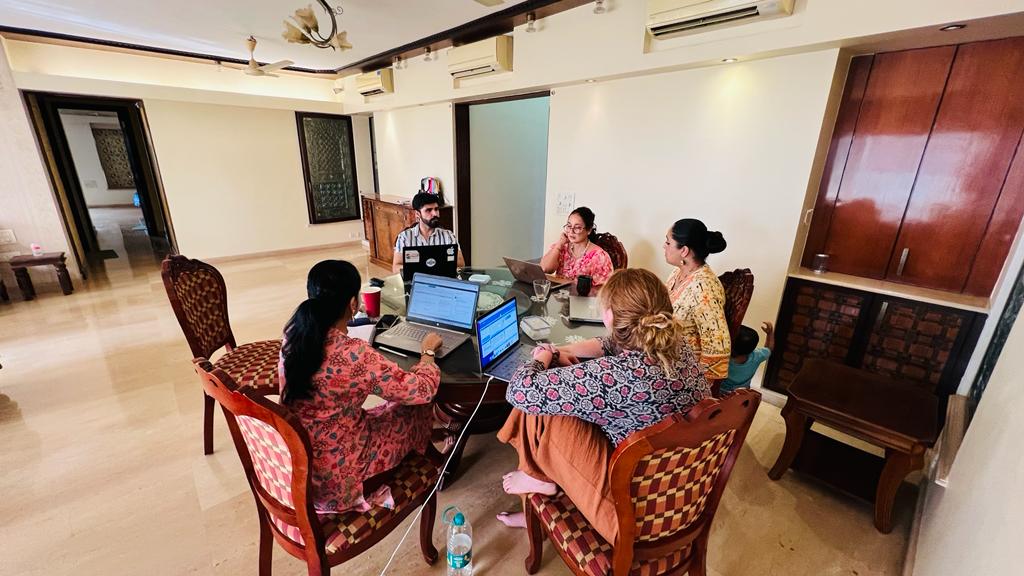
Of course the primary reason I was on this trip was to meet up with my research collaborators. After two years of zoom and google-hangout calls, I was actually seeing them and their office space in-person! This was invaluable. Being in-person meant I could better get to know the community, experience the atmosphere, and enjoy the everyday interactions filled with humor, fun, and lots (I mean, LOTS) of food, which made me feel very welcome.
One of my favorite experiences was sitting around the office where we had just finished eating dessert (I had gulab jamun for the first time which tasted amazing) and I briefly left the room to wash my hands. When I returned, singing and dancing had broken out. I was told this was a badhai performance which are songs, dances, and prayers often performed by Hijra, Trans, or other socially marginalized communities. Hijra are widely referred to as a “third gender” and do not conform to the gender binary. The performance I witnessed was from members of the Hijra community who were visiting the Humsafar office that day. We all cheered and clapped as they performed 3 songs. I asked those around me what prompted this performance and learned it was a celebration as they were getting certificates today which recognized them as official members of the Hijra community.
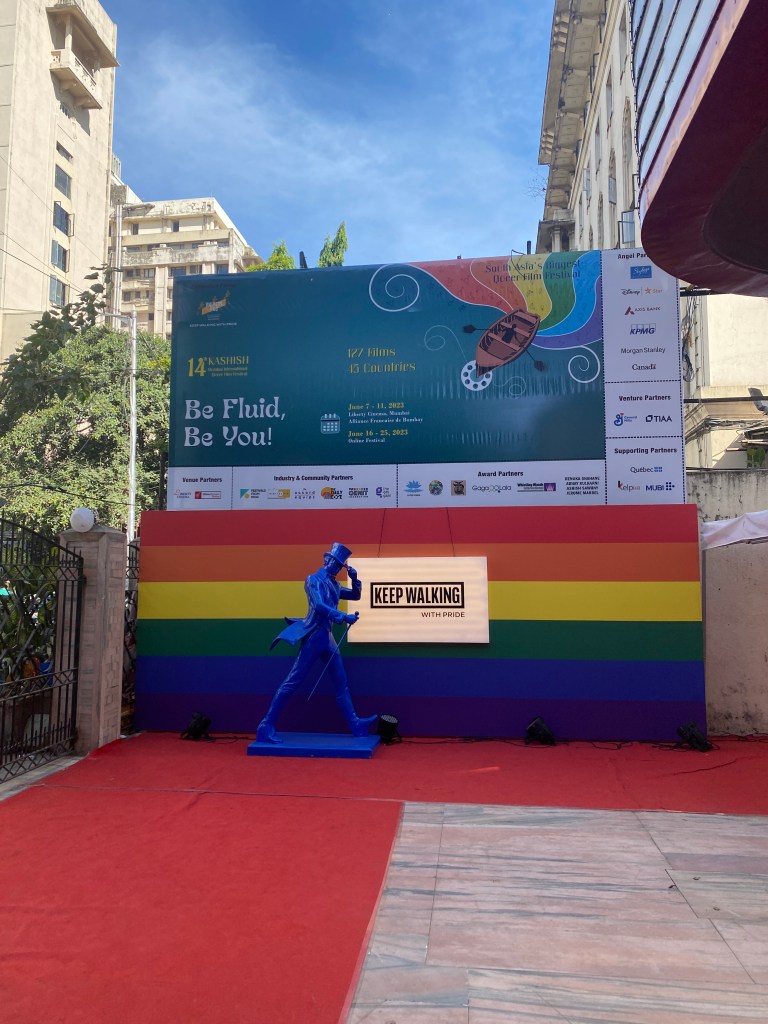
Later on my trip, I attended Kashish, Mumbai’s International Queer Film Festival, where I got to see members of the queer community come together and discuss their struggles for recognition and visibility in this context where there still remains a lot of stigma around identifying as queer. Listening to their experiences helped me to better contextualize the research I am doing with this community, in ways I couldn’t understand on a zoom call from the US.
Challenges and Confusions
Of course my trip was not without challenges. For one, crossing the street felt like putting my life on the line. Traffic lights were few and far between, especially where I was staying in the Bandra neighborhood. If you wanted to wait for traffic to stop, you’d be waiting forever. At first, I was frantically running across the street, dodging oncoming traffic and desperately hoping I’d make it across (this sounds dramatic but really was true!). When expressing my difficulties to my friends there, they laughed and told me that “Indians have the power of the hand” and that you just need to extend your hand when crossing the street and no one would hit you. It was true that in watching locals cross the street, they seemed to magically glide across the street, with seemingly no concern for oncoming traffic.
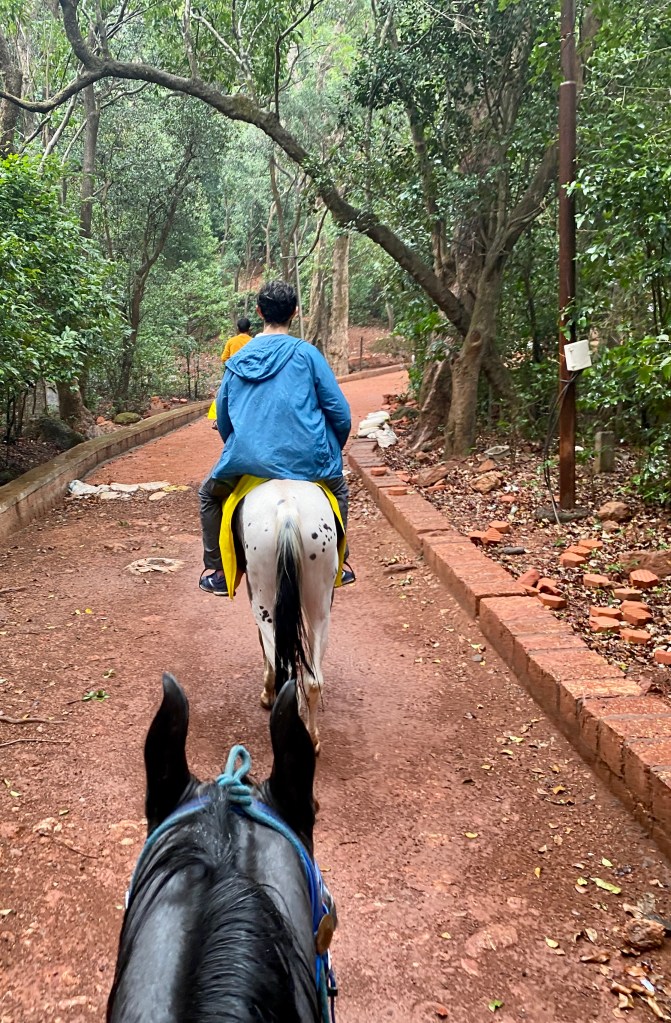
My trip was also full of moments of confusion, such as the time my Uber driver got out of the car mid-ride on the Bandra-Worli Sea link bridge and left for five minutes and then returned with little explanation (I’m very grateful he returned given my phone connectivity was not working and I had no idea what to do if he didn’t return). Or when my partner and I traveled outside the city for a night to a hill-station called Matheran and in trying to get to our hotel, ended up on a 6-hour horse-back riding tour (neither of us ride horses but were forced to quickly figure it out!). This did however lead to one of the coolest experiences. I mean, it’s not often you get to ride horses through a forest in India with monkeys swinging around you.
Personal Reflections on Positionality
A trip like this made me reflect on my own role and positionality. It was an immense privilege for me to be able to travel to Mumbai, funded by my advisor and a sexualities research grant at Northwestern University. While Mumbai is the most populous city in India and very multicultural, in many of the spaces I was in, I was the only white person. This meant that particularly in public and crowded spaces, such as the Gateway of India or along the water, I was often stared at, asked for money, or to take a picture/selfie. One of my collaborators told me that my blonde hair would likely attract extra attention. This attention was uncomfortable for me to navigate, especially as someone who generally does not enjoy attention on me.
At the same time I became aware that – in certain spaces – my white skin gave me certain privileges. In one instance I was meeting a friend at a relatively wealthy establishment in the Juhu neighborhood and the rickshaw I was in was stopped when entering through the gates and waved away. When I popped my head out of the rickshaw to see what was going on, in seeing me, the security guard apologized and waved us right through. While I was glad to be waved through, I was aware this was a result of my own white privilege. My appearance served as a marker of belonging and wealth, which was interesting for me to contend with when in the US my graduate student stipend is just enough to live on. I wanted to further understand my experience and I found this article, which discusses migrant experiences and the ways in which particularly white men benefit from positive stereotypes in that they are believed to be wealthy and a boon to the economy. The author argues we need to better understand the role that white privilege plays in the global economy.
While my white skin afforded me certain privileges, my gender also impacted how I was treated (surprise surprise). I was traveling with my male partner and most of the people we encountered would address him and assume he was paying for any purchases. Of course this happens in the US too, but not as overtly as I experienced in Mumbai in that sometimes I really felt invisible. Some of these dynamics were already apparent on the visa application for traveling to Mumbai as when I indicated my occupation to be a student, I couldn’t continue with the application until I indicated my husband or father’s job (which was especially difficult and somewhat distressing to answer as I am unmarried and my dad has passed).
I spent many hours with my research collaborators discussing gender dynamics and the difficulties of wanting to work as a woman in India while also being married and expected to cater to their partner’s needs. According to my collaborators, even when women are unhappy, they feel forced to stay in marriages as being a divorced woman is highly stigmatized and seen as very low status. In discussing marriage, one of my collaborators, half jokingly said, “I advocate for marriage equality because everyone has the right to be miserable.”
All in all, this trip was full of many experiences for which I am incredibly grateful and definitely one of the most special and fulfilling parts of my PhD thus far. In returning to Chicago, there were of course things I looked forward to such as being able to drink the tap water without having to worry about an upset stomach and having street-crossings that felt less of a life-threatening endeavor. Yet I’m excited for when I can next see my friends and collaborators in Mumbai and further understand and immerse myself in the culture there.
 Annika Pinch